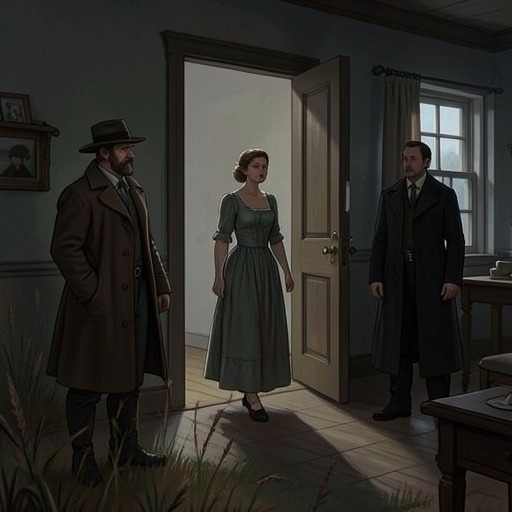
Two deaths at Nuestra Señora de las Lágrimas
La piel del tamborThe two deaths at Nuestra Señora de las Lágrimas—the fatal fall of municipal architect Peñuelas and the death of Father Urbizu beneath falling plaster—turn a dispute over a crumbling church into a question of accident, danger, and suspicion. The police and the archbishop present both deaths as misfortunes, not proven crimes; yet the church’s precarious condition and the deaths’ connection to its threatened demolition give them a persistent, ominous weight. Their meaning remains unsettled: the available evidence supports the accident findings, but not a claim that every question has been answered.
The deaths and the official account
The first death occurs during Peñuelas’s visits to the church in his capacity as municipal architect, preparing a report on its ruinous condition. He has argued with Father Ferro, who is described as far from mild-tempered, but the archbishop’s account makes no causal connection between those quarrels and the fatal fall. While moving around the roof, Peñuelas leans on a wooden railing; it gives way, and he falls onto a partly installed metal pipe, which impales him. The archbishop describes the railing as the immediate cause and insists that there was nothing mysterious about the death.
Peñuelas was not alone. Another official was with him, as was Father Óscar, the parish vicar, who administered the last rites. That witness context is important to the official explanation: when Lorenzo Quart asks whether anyone had accompanied the architect, the archbishop answers that the circumstances leave nothing dark on that side. The presence of others does not erase the grim mechanics of the fall, but it distinguishes the incident from an unwitnessed disappearance or an attack concealed from investigators.
The police account adds an inspection of the scene. Simeón Navajo tells Quart that Peñuelas had spent half an hour walking over the roof in search of material for the ruin report before leaning against the railing near the bell tower. The wood was rotten, it gave way, and Peñuelas fell onto the metal tube. The fall took place in front of witnesses, and the subsequent inspection could not establish that the railing had been tampered with. The physical explanation and the lack of evidence of interference underpin the police conclusion that the death was accidental.
Father Urbizu’s death is likewise explained through the church’s deteriorating fabric, but its circumstances differ. There were no witnesses to the fatal moment. Navajo says that investigators searched the church from top to bottom; their reconstruction is that Urbizu may have leaned on a scaffold or moved it accidentally. The upper end of the scaffolding struck the cornice and dislodged a large piece of plaster that may already have been loose. Weighing more than ten kilograms, it fell onto Urbizu’s head. The officer offers a plausible sequence rather than a witnessed account, and the absence of witnesses leaves this explanation less directly observed than the one for Peñuelas.
The building as evidence
The church’s condition links the deaths while also complicating the case for demolition. Gris Marsala acknowledges that Nuestra Señora de las Lágrimas has not been cared for in a century and a half, but disputes the claim that its structure is unsound: the walls and vault, she says, have no irreversible cracks. Her distinction between neglected appearance and structural stability challenges the language used by the City Council, the bank, and the archbishopric to justify pulling the building down.
The plaster that killed Urbizu is visible evidence against any easy dismissal of the danger. Gris points to a gap nearly a metre long in the cornice, about ten metres above the nave, where a gilded piece of plaster is missing above the pulpit. She calls Urbizu’s death a case of bad luck, as she does Peñuelas’s fall. The damage proves that part of the church was hazardous; it does not, by itself, prove that the entire building was beyond repair. The same two deaths can therefore be used in opposing ways: as warnings about neglected fabric and as leverage in a redevelopment dispute.
The church’s danger becomes part of its reputation. Gris tells Quart that there are places and people one cannot pass through without consequence, naming the city, the church, Father Príamo Ferro, and Macarena Bruner. Her warning makes the deaths feel larger than two entries in a police file, but it does not overturn the official findings or identify a perpetrator. The ominous atmosphere belongs to the story’s framing of the place; it remains distinct from proof of homicide.
Investigation and unresolved suspicion
Navajo’s manner combines professional confidence with dark comedy. Reviewing the files with Quart, he says the forensic opinions and police conclusions agree: both deaths were accidents. He jokes that a rotten railing and a falling piece of plaster selected two unlucky victims, and gestures his way through Peñuelas’s fall as if demonstrating a chicken being skewered. His theatrical retelling makes the material sequence memorable, even as its levity sits uneasily beside the deaths it describes.
For Urbizu, Navajo similarly reconstructs the possible movement of the scaffold, the plaster’s fall, and the blow to the priest’s head. He admits that there were no witnesses, while emphasizing that his officers examined the church closely. The account is therefore a reasoned reconstruction grounded in the site’s condition, not direct testimony to the fatal instant. Taken together, the two police explanations distinguish what is known—the failed railing, the damaged cornice, the inspection—from what remains inferred about how Urbizu’s accident unfolded.
The evidence does not license a conclusion that Peñuelas or Urbizu was murdered. It does, however, preserve a tension between official findings and the persistent suspicion surrounding the church. The deaths are called mysterious by others and accidents by the archbishop, the police, and Gris; their recurrence at the same contested building keeps the question alive without answering it. A later discovery of a third body in the church changes that atmosphere, but it does not retroactively establish foul play in either of these earlier deaths.
Ritual, memory, and consolation
The deaths also acquire meaning through the church’s daily life, not only through its construction and inspection. The archbishop tells Quart that Ferro celebrates Mass every day at eight in the morning, except Sundays and holidays, when he celebrates twice. Quart later attends a service in the half-occupied nave, where parishioners sit among scaffolding and damaged surfaces. Ferro wears old-fashioned vestments, including the amice and an older guitar-shaped chasuble, and uses Latin for portions of the Mass that are not directly addressed to the congregation. That practice sits uneasily with the Church’s post–Second Vatican Council requirement that Mass be celebrated in the parish’s own language to encourage understanding and participation.
Yet Quart sees that ritual’s effect cannot be reduced to a question of compliance. Despite his skepticism and dislike of Ferro, he is moved by the priest’s solemn gestures and by the attention of the tired congregation. What matters to those gathered, Quart recognizes, is consolation: a shared rite, a familiar voice, and the possibility of a friendly hand in darkness. The church where two men have died is also a refuge for people who bring their vulnerability there; the deaths sharpen, rather than cancel, that contrast.
Ferro’s own account makes this consolation inseparable from doubt. At sixty-four, he says he has forgotten the ancient philosophy he once read, retaining only a bitter-sweet melancholy and disillusionment; what he knows of people is that they remember, fear, and die. He recalls a quarter-century of sitting beside the dying, whose hands clung to his because he was their only consolation, while his prayers to God received no answer. He describes faith not as a settled explanation of suffering but as a form of hope and comfort against the thought that human life ends without meaning.
That is why Ferro defends Nuestra Señora de las Lágrimas even while allowing that his own faith may be uncertain. The people who come to the church believe, he argues, and that belief is reason enough for its existence. He associates its Baroque art with overwhelming the senses rather than inviting analysis, warning that truth can kill hope prematurely. Quart objects that such consolation risks alienating its recipients; the disagreement leaves the deaths within a wider conflict over whether comfort is a necessary shelter or an evasion.
The church’s continued Mass also has a concrete legal and material consequence. Ferro tells Quart that the building remains protected so long as a Mass is celebrated for the soul of Gaspar Bruner de Lebrija each Thursday at eight in the morning, the hour and day of his death in 1709. On those Thursdays, an archbishop’s representative and a notary paid by Pencho Gavira sit in the back pews, watching for an irregularity or lapse that might endanger the protection. The ritual is therefore both a pastoral practice and the condition on which the building’s survival depends: repeated words and gestures stand between the church and demolition.
The two deaths frame that precarious arrangement. One man dies while documenting the church’s ruin; the other dies when a piece of its damaged interior falls. Neither death proves that the building must be destroyed, nor does the evidence prove that either was deliberately caused. Their lasting force lies in this unresolved double significance: the church is materially dangerous and politically vulnerable, yet it remains a place where people seek consolation, memory, and a reason to endure the knowledge that they too will die.